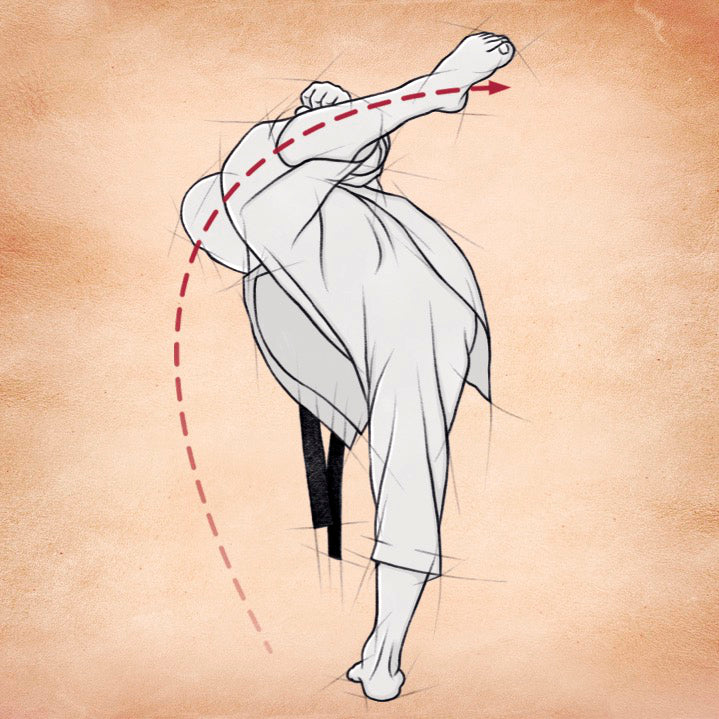
BIOMECHANICS
Biomechanics is the application of physics to living organisms.
In karate, it transforms the body from a biological entity into a highly efficient physical system. Instead of relying on pure muscle strength, an advanced karateka utilizes principles such as conservation of momentum, kinetic chains, and torque.
Kinetic Chains (Force Flow)
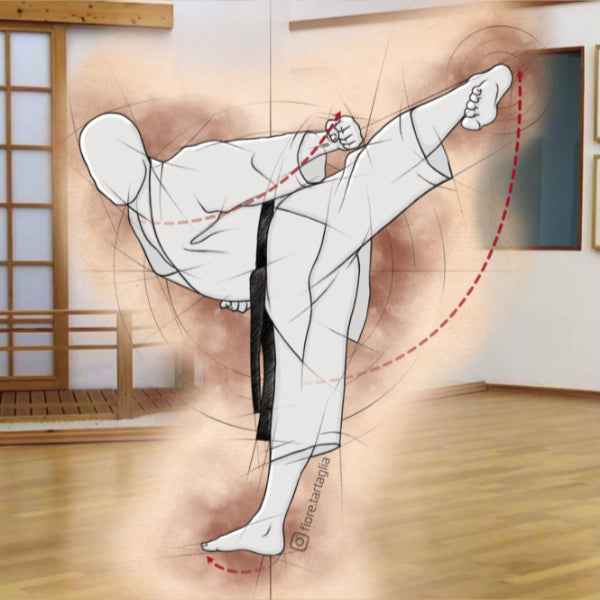
Force in Karate should not unfold in the arm or leg alone, but throughout the entire body. It is almost always initiated at the ground and guided upward through the body.
- Ground Reaction Force: The initial energy is generated by pushing off the ground. This is also simply referred to as ground force.
- Energy Flow: The energy flows from the large, slow muscle groups (legs, hips) to the small, fast groups (shoulder, arm, fist).
- Sequential Acceleration: Each body segment begins its maximal movement only after the preceding one has reached its peak velocity.

Maximizing Impact
To maximize the impact of a technique, one must increase either the velocity or the effectively deployed mass.
- Kime: At the moment of impact, the entire body is tensed for a fraction of a second. As a result, it is not just the mass of the fist that acts, but the inertia of the entire body weight behind the technique.
- Hip Rotation: Through rotation, the mass of the upper body is integrated into the linear movement of the technique.
Torque
Many karate techniques (such as roundhouse kicks or defensive blocks) are based on rotational physics.
- Hikite (Pulling Hand): By rapidly pulling back the opposing hand, a rotational torque is generated in the upper body, which causes the striking hand to snap forward like a whip.
- Axial Stability: A stable vertical spine minimizes energy loss caused by unnecessary swaying and allows for faster rotation.

Striking Surfaces
In application, physical pressure plays a decisive role.
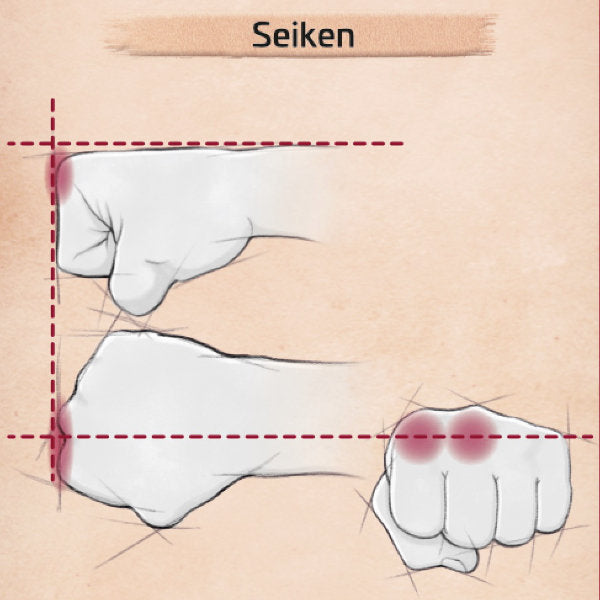
- The precision of the contact area is crucial: karate teaches hitting with a very small surface area, for example, using only the first two knuckles (seiken) or the ball of the foot (koshi) in mae geri. A smaller contact area exponentially increases the pressure at the target for the same amount of force.

Biomechanical Stability (Stances)
In karate, a stance is not a static pose, but an active utilization of the center of gravity.
- By bending the knees, the center of gravity is lowered, which increases stability.
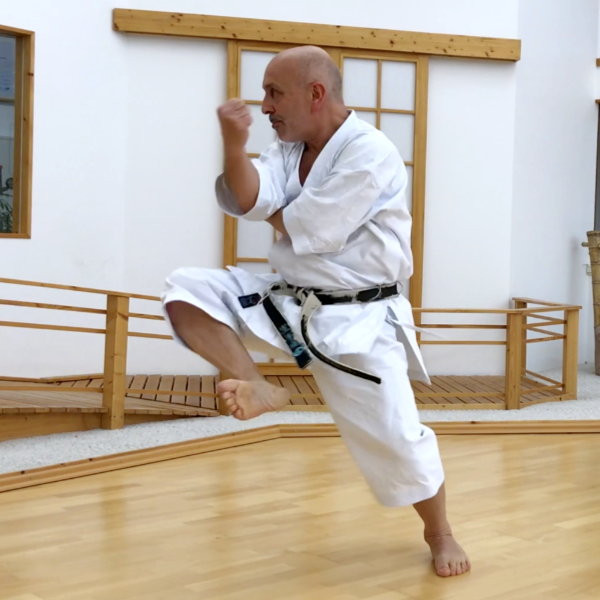
- In stances like zenkutsu dachi, forces are directed in such a way that the recoil of a hit is channeled directly into the ground instead of throwing the karateka backward.
Karate is "applied physics in perfection." A strike is not an isolated act of the arm, but a coordinated discharge of ground reaction force, amplified by rotation and massively condensed by Kime.

Biomechanics and kata
Since a kata lacks the resistance of an object, the body must stop the generated energy itself without damaging the joints.
- Muscles and tendons are eccentrically pre-stretched like rubber bands (e.g., during the preparation of a technique) and then snap together concentrically.
- At the end point of the technique, the movement is abruptly stopped by the simultaneous contraction of agonists and antagonists (opposing muscles). The kinetic energy is not dissipated but compressed within the body in a fraction of a second. This creates the typical "snap" sound of the uniform and the visual sharpness of the kata.
- Axes of Rotation: During a body turn, the supporting leg acts as the axis of rotation. The closer the mass is kept to the center (e.g., by drawing the feet close together), the faster and more stable the rotation is (conservation of angular momentum).
- Force Vectors: A blocking technique to the side immediately after a punch forward requires the instant redirection of linear momentum into circular momentum. The biomechanics of kata is demonstrated by mastering this transition without any visible loss of tempo.
While kumite is about transferring physics onto an external object, kata is the mastery of physics over one's own body. It is the visualization of invisible forces–push, pull, rotation, and grounding–in a perfect geometric form.