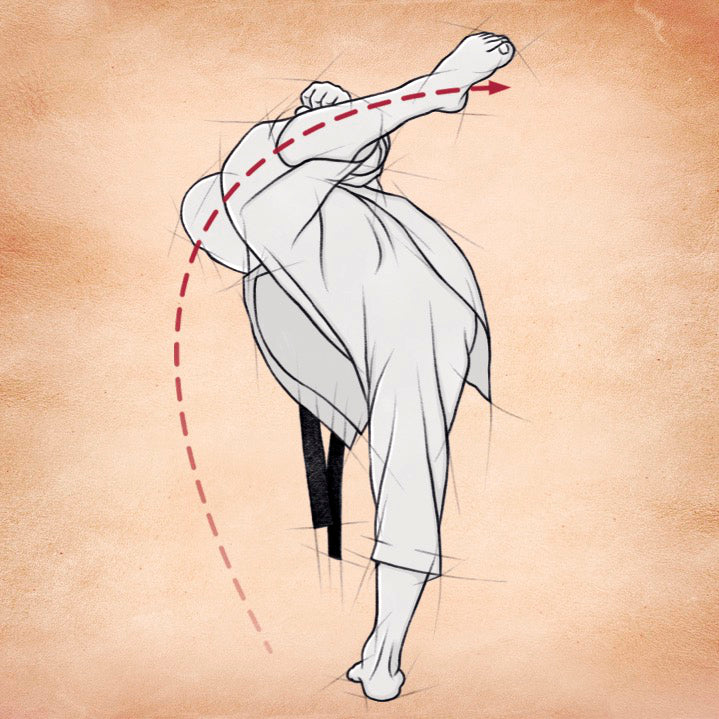

I've often wondered why we sometimes block ourselves, even after years of training. It's become clear to me: understanding can take a long time because you're using your intellect. We try to grasp everything with logic – but in the crucial moment, that's precisely our biggest enemy.
The Wisdom of "Madness"
I often recall a Zen quote that deeply moved me: "There is a wisdom that can only be attained when you go mad and let go of your mind."
That sounds paradoxical at first, doesn't it? But when I apply it to Karate, it suddenly makes sense. In a fight, conscious, controlled defense is ironically an obstacle. I've experienced firsthand how it drastically slows down reaction time.
What actually happens inside us?
I've closely observed the process: to defend, we need an impulse – the conscious perception that an attack is coming. This information reaches the brain, which then sends a command to the muscles, which then execute a defensive technique.
Do you notice the detour?
This is precisely where the obstacle lies. This process makes the Karateka slow. And it is prone to errors: the attack can be faster than our thought. It can be a feint, a series, or a combination to which our mind cannot react quickly enough.
The Blocking of Our Instincts
What have we actually caused with this? I think we've made a crucial mistake: we've limited an instinct. The deep knowledge we carry within us after years of accumulated experience has been blocked by forced thinking. We get in our own way with our logic.
What now? The Path of Letting Go
My advice to myself and to you: Don't try to understand and don't think. Just let go.
The crazy thing about it: An attack comes, and we don't think about defense. We don't act in the classical sense; instead, we relax. In that moment, when the ego and the planner within us are silent, we unleash our potential, allowing it to unfold.
Karate master Kenji Tokitsu aptly writes in his book Ki and the Way of the Martial Arts: "There is no Karate without Zen."
How does one practice this?
Not through a specific technique, but through a way of training. In Jiyu Ippon Kumite, for example, you can consciously refrain from preparing a response. Wait for the attack without a plan, without expectation. The time before and after training is also important: a few minutes of Mokuso, where you let your breath calm down, train precisely the quality needed in combat. It is an exercise that one does not "achieve" but cultivates over time.
Not just in the Dōjō
This principle doesn't end with the Kiai at the end of training. Who hasn't experienced it: In an important exam, in a difficult conversation, or when making a decision under pressure, the mind suddenly gets loud, and precisely then we lose access to what we are actually capable of. Karate precisely trains this ability to remain calm and trust in the decisive moment. The Dōjō is just the training ground. Life is the actual field.
My Opinion
In my book on self-reflection How do you know it's true? (for now just available in German and Italian) the master says a sentence that still accompanies me today: "Understanding can take a long time because you use your intellect. If you let go and relax, you will understand without delay."
It's not about neglecting one's own knowledge, but about releasing the true knowledge from our subconscious – free from thoughts or intentions. If we have the courage to behave "madly" in the Zen sense and let go of our minds, a clarity emerges that needs neither time nor space.
It's about a dimension that enables us much more than we can imagine.