
Training course from October 4th with C. Heinrich, F. Oblinger & F. Tartaglia
With our largest training course of the year, we were delighted to welcome back three instructors who have all previously conducted training courses with us and were invited back at the request of many. We are, of course, all the more pleased that everyone agreed to return.
The instructors we are reporting on today are: Fritz Oblinger (9th Dan Shotokan and 9th Dan Kyusho Jitsu), Fiore Tartaglia (7th Dan Shotokan), and Christine Heinrich (4th Dan Shotokan). With these many facets of karate, there was something interesting for everyone, and to ensure that every participant had the opportunity to learn from each instructor, each instructor was assigned a session at every training level. In addition to the event itself, our instructor and chairman, Bernhard Dietz, was awarded the Gold Badge of Honor from the SKB (Saxon Karate Federation) and the Silver Badge of Honor from the LSB (State Sports Federation) for his 30 years of active participation as a karateka.
The students from 9th to 5th Kyu began their training with Christine. After a short warm-up, she explained to the participants how important posture is for basic stances such as Zenkutsu Dachi, Konkutsu Dachi, and Kiba Dachi, and how hip movement interacts with these stances and posture to make the techniques more effective. Basic attack and defense techniques were then added to complete the overall framework.
Fiore took over the training for the second session and explained the basic structure of the greeting. He covered everything from the historical background to the execution, paying attention to detail and the interaction with oneself within this ritual. For the technical training, he emphasized the importance of defensive movements and how much influence rotation and hip movement have on a successful defense. For this, the participants had to practice turns in Konkutsu Dachi in a very confined space, with their backs to the wall.
Fritz concluded the training for this grading with an overview of trigger points and the body's energy flow. He showed the participants not only how the body reacts to various stimuli, sometimes more and sometimes less painfully, but also how this overstimulation of the body can be used to manipulate the opponent to one's own advantage.
Participants from 4th to 1st Kyu began their training day with Fiore by discussing the distinction between traditional and sport karate. He explained that both styles have their advantages and disadvantages. For the training session, however, he focused specifically on hip rotation and striking movements, building upon his explanation that most techniques in traditional karate are meant to be executed very quickly, quietly, and originating from the hips. He also incorporated the principle of hip movement as a driving force into a partner exercise at the end to add a greater physical challenge.
In his session, Fritz focused on the kata Shin-Gi-Tai. Essentially, it's a training form designed to cultivate three pillars: mind, technique, and body. He expanded upon the principles of the techniques with several applications and partner exercises. Later, he incorporated specific striking points from Kyusho into the partner exercises to further refine the participants' precision.
For the final session, Christine focused on the two katas Basai Dai and Enpi. She structured her training with targeted exercises on the fundamental techniques of the katas, emphasizing the understanding and correct execution of each technique, especially the preparatory movements. Afterward, she moved on to the sequence of the katas and the integration of the details into the kata.
For the Dan grading students, the day began with Fritz's kata Gojushiho. This is neither the Dai nor the Sho version, but an older form taught under Itosu. Besides practicing the kata itself, several sequences were extracted as bunkai and practiced with a partner. These were then combined with various kyusho applications to offer each student several variations of the kata's application.
The topic Christine addressed in her session, at the organizer's request, was the kata Meikyo. Similar to her session with the intermediate level, she first focused on the more complex sequences of the kata, particularly the hip rotation during the turning movements. In addition to the turns, she also emphasized the importance of alignment at a 45° angle to the movement, as a significant amount of energy can be lost during these transitions. After discussing the techniques, she moved on to the execution of the kata itself, as well as some partner exercises where one partner performed part of the kata while the other partner completed the second half.
Fiore concluded the session for the Dan participants, first addressing the mental aspect of concentration and the importance of being "present," not only in training but also in everyday life. He explained that in training, a lack of presence can not only slow progress but also be dangerous when interacting with a partner. He repeatedly paused the training to emphasize this point. Furthermore, he incorporated the importance of hip movement in evasive and defensive movements into the Dan training, practicing it not only through kata sequences but also incorporating it into partner drills. Finally, he returned the focus to the themes of evasion and presence, having the participants work on these concepts in larger groups. The challenge was for one person in each group to remain as relaxed as possible and hold their own against multiple opponents.
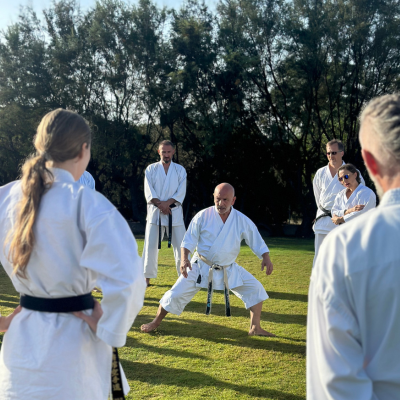
As the day draws to a close, we would like to thank not only the trainers for the excellent training and the opportunities for diverse perspectives, which allowed for valuable exchange and learning, but also the more than 100 participants, who were represented in large numbers across all levels. We hope to see you all again soon!
Text: Aaron Polland
Photos: Alissa Lynn Polland