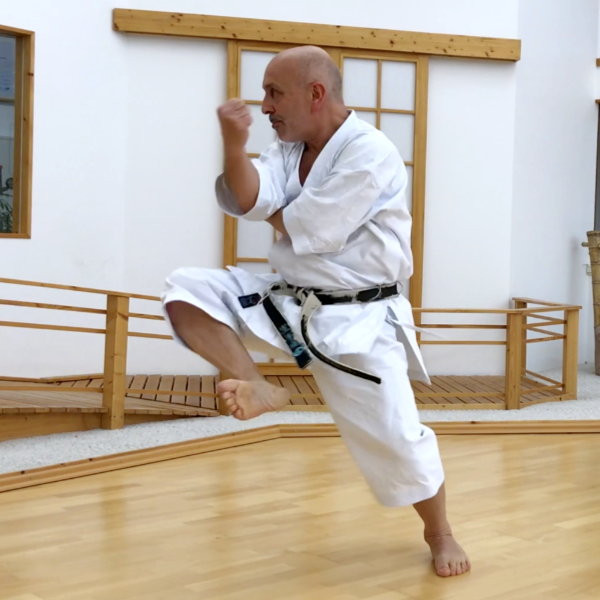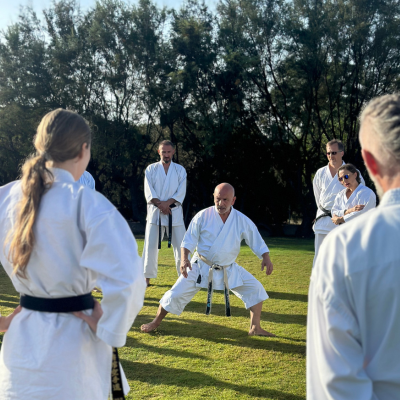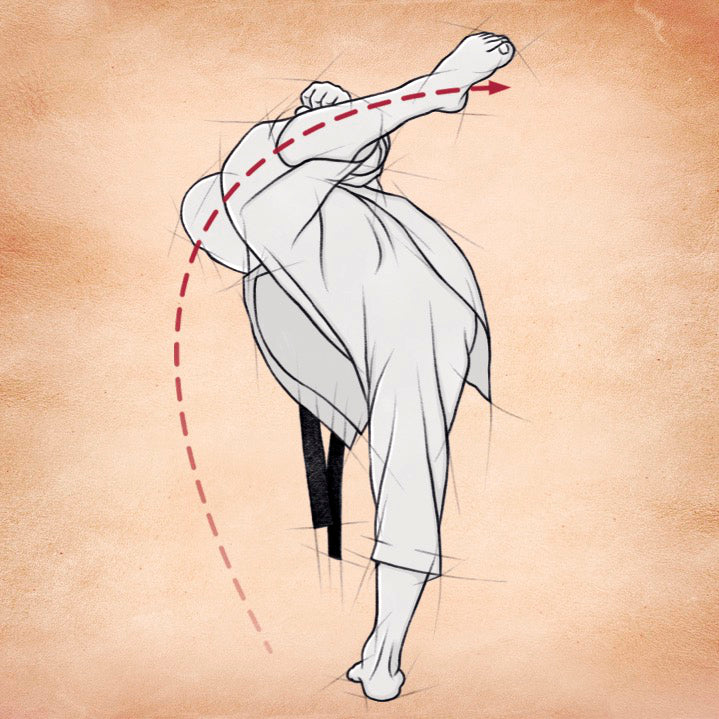

Anyone who trains in karate knows the picture: A group of karateka performs a kata. The movements are precise. The sequence is correct. And yet something is missing.
What's missing is hard to name, but easy to feel. The kata is demonstrated, not lived.
What Kata really is – and what it isn't
In Western training, kata is often treated as a mandatory exercise. You learn the sequence, practice it for exams, and repeat it in kihon training. This isn't wrong. But it's too superficial. Kata is not a movement test, but a learning method.
Every Shotokan kata contains a structured system of techniques, principles, and transitions. This structure is no accident, as it has been developed and refined over generations. Those who treat it merely as a sequence overlook its true content.
The Heian Kata: underestimated and fundamental
Few groups of kata are as consistently underestimated as the five Heian kata. They are considered beginner forms and are therefore often discarded once the blue belt is achieved.
In Western training, kata is often treated as a mandatory exercise. You learn the sequence, practice it for exams, and repeat it in kihon training. This isn't wrong. But it's too superficial. Kata is not a movement test, but a learning method.
Every Shotokan kata contains a structured system of techniques, principles, and transitions. This structure is no accident, as it has been developed and refined over generations. Those who treat it merely as a sequence overlook its true content.
The Heian Kata: underestimated and fundamental
Few groups of kata are as consistently underestimated as the five Heian kata. They are considered beginner forms and are therefore often discarded once the blue belt is achieved.
This is a mistake.
The Heian kata contain, in a compressed form, the central principles of Shotokan Karate: body structure, weight shift, timing, distance, Zanshin. Those who have only a superficial knowledge of these kata have learned a technique. Those who truly penetrate them have a foundation.
An experienced karateka always returns to the Heian kata – not because they don't know them yet, but because they find more in them each time.
The most common mistake in kata training
Most karateka train kata too quickly and too much.
This sounds paradoxical. More training should mean more progress. In practice, it often leads to the opposite: the movement becomes automated before understanding is present. What follows is mechanical (sometimes incorrect) execution without inner involvement.
The difference between a karateka who stagnates and one who develops rarely lies in the training volume. It lies in the quality of attention.
Studying kata means: slowing down. Asking questions. Isolating a single sequence and honestly examining it:
Technical precision and substantive understanding – both belong together
There are two common one-sidedness in karate training.
The first: karateka who focus exclusively on technical precision. Angles, stance, execution. This is important, but without substantive understanding, the technique remains empty.
The second: karateka who talk about principles without physically embodying them. This is interesting, but without a technical foundation, it remains abstract.
Developing both together is the actual goal. And for that, you need methods, not just repetitions.
A proven method is the written examination of the kata: movement by movement, with clear commentary on technique and principle.
Learning Kata in the digital age – possibilities and limitations
The dojo remains the central place for karate training. No video, no book, no digital platform replaces direct correction by an experienced teacher or joint training with other karateka.
At the same time, the way karateka learn between training sessions has changed. Video analysis, structured online content, and annotated learning materials can usefully supplement dojo training if they are developed with the same demand for accuracy and depth as good specialized literature.
The FT-KARATE Kata Academy, which will soon launch with the Heian series, follows exactly this approach: not a substitute for training, but a structured tool for a deeper understanding of kata.
Kata as a mirror of one's own development
Kata shows what is truly there and not what you think you can do, nor what you can cover up in kumite. But what is actually present: in terms of structure, concentration, body control, and inner attitude.
This sometimes makes kata uncomfortable, and that's precisely why it is so valuable.
Whoever trains kata honestly – not to demonstrate it, but to develop themselves – practices karate in the true sense of the word. As a path. As a method. As a tool for personal development.
The first step is simple: start the next training session with a single question. Not: "What does it look like?" – but: "What does it mean?"
An experienced karateka always returns to the Heian kata – not because they don't know them yet, but because they find more in them each time.
The most common mistake in kata training
Most karateka train kata too quickly and too much.
This sounds paradoxical. More training should mean more progress. In practice, it often leads to the opposite: the movement becomes automated before understanding is present. What follows is mechanical (sometimes incorrect) execution without inner involvement.
The difference between a karateka who stagnates and one who develops rarely lies in the training volume. It lies in the quality of attention.
Studying kata means: slowing down. Asking questions. Isolating a single sequence and honestly examining it:
-
- Structure: Does my body structure align with the intention?
- Intention: What is the immediate intention of this movement?
- Principle: What mechanical principle underlies it?
- Essence: What deeper concept manifests itself in this passage?
Technical precision and substantive understanding – both belong together
There are two common one-sidedness in karate training.
The first: karateka who focus exclusively on technical precision. Angles, stance, execution. This is important, but without substantive understanding, the technique remains empty.
The second: karateka who talk about principles without physically embodying them. This is interesting, but without a technical foundation, it remains abstract.
Developing both together is the actual goal. And for that, you need methods, not just repetitions.
A proven method is the written examination of the kata: movement by movement, with clear commentary on technique and principle.
Learning Kata in the digital age – possibilities and limitations
The dojo remains the central place for karate training. No video, no book, no digital platform replaces direct correction by an experienced teacher or joint training with other karateka.
At the same time, the way karateka learn between training sessions has changed. Video analysis, structured online content, and annotated learning materials can usefully supplement dojo training if they are developed with the same demand for accuracy and depth as good specialized literature.
The FT-KARATE Kata Academy, which will soon launch with the Heian series, follows exactly this approach: not a substitute for training, but a structured tool for a deeper understanding of kata.
Kata as a mirror of one's own development
Kata shows what is truly there and not what you think you can do, nor what you can cover up in kumite. But what is actually present: in terms of structure, concentration, body control, and inner attitude.
This sometimes makes kata uncomfortable, and that's precisely why it is so valuable.
Whoever trains kata honestly – not to demonstrate it, but to develop themselves – practices karate in the true sense of the word. As a path. As a method. As a tool for personal development.
The first step is simple: start the next training session with a single question. Not: "What does it look like?" – but: "What does it mean?"